
There is a point many experienced HR professionals reach in their career where simply supporting, coordinating or implementing is no longer enough.
You want to shape better solutions. You want to influence what gets prioritised. You want to work in a way that connects effort to measurable impact. And, increasingly, you want to understand how HR can keep delivering value in a world where AI is becoming part of almost every process, tool and employee experience.
This is where Product Ownership becomes much more interesting for HR.
Product Ownership gives HR professionals a practical way to move from fragmented coordination to end-to-end value delivery. It creates clearer decision ownership, stronger prioritisation and a more disciplined way of improving the products, services and experiences HR delivers to employees, managers, leaders and the business.
And for ambitious HR professionals who care deeply about the quality of their work, it offers something else too: a route to more influence.
Why HR needs Product Owners now
HR work has become too complex to be managed through disconnected ownership.
Take performance management. In many organisations, a Centre of Excellence may “own” the concept. They design the model, create the PowerPoint, define the process and imagine the employee and manager experience.
Then they approach the HR technology team, because the experience is partly or fully enabled through systems. Constraints appear. Some ideas are too expensive, complex or not possible in the current platform.
Then, when the product or process is finally built, it may be handed over to HR services or HR operations, which inherit the live questions, cases and issues. HR Business Partners support leaders and employees. Data may sit somewhere else. Feedback may be gathered, but not always acted on. The original concept owner may already be moving on to the next priority.
If you don't know where to send the KPIs, metrics and feedback, that is a warning sign that nobody truly owns the product.
Riina Hellström, Founder & Agile Enterprise Coach
The result? Nobody truly owns performance management end to end.
The concept is owned somewhere. The technology is owned somewhere else. The service experience is owned elsewhere. The data is scattered. The improvement loop is weak.
This creates…
- Poor delivery
- Frustration for users
- Job dissatisfaction for the HR professionals trying to make the whole things work.
AI makes this even more urgent.
As HR teams experiment with AI agents, copilots, automation and AI-enabled tools, ownership becomes even more complex. It is no longer enough to ask who owns the process or the platform. Someone also needs to understand the AI layer: the data, prompts, context libraries, documents, decision logic, testing routines, maintenance model and risks.
If the performance management process changes, the AI coach, knowledge base or automated guidance connected to it may need to change too. You cannot simply launch it and leave it sitting there.
AI-enabled HR products need continuous ownership. They need testing, feedback, improvement and governance. That is exactly the kind of discipline Product Ownership brings.
What Product Ownership makes possible
A client needed a new performance management coach to help people set better goals. With the help of AI, they developed an AI coach in just two weeks for a global organisation of around 25,000 people. Normally, something like that might take six months to a year.
That speed did not come from AI alone. AI helped accelerate the work, but Product Ownership and agile discipline gave the work structure, direction and value. The team was not simply experimenting with a tool. They were developing a product with users, outcomes and delivery in mind.
This is the real opportunity for HR. AI can speed up development, but Product Ownership helps make sure that speed leads to structured, valuable delivery.
What Product Owners actually do
A Product Owner is responsible for making sure a product creates value for its users and the organisation.
In HR, that product could be onboarding, performance management, employee listening, career development, internal mobility, learning, workforce planning, manager support or an AI-enabled HR service.
A Product Owner does not just manage tasks. They understand users, stakeholders, needs, constraints, value, risks and organisational priorities. Then they make decisions about what should be built, improved, released, paused or stopped.
That distinction matters.
Product Ownership is not project management. A project manager often coordinates a defined piece of work. A Product Owner owns the ongoing value of the product. They work with a cross-functional team, prioritise the backlog, make trade-offs, review evidence and guide development in increments.
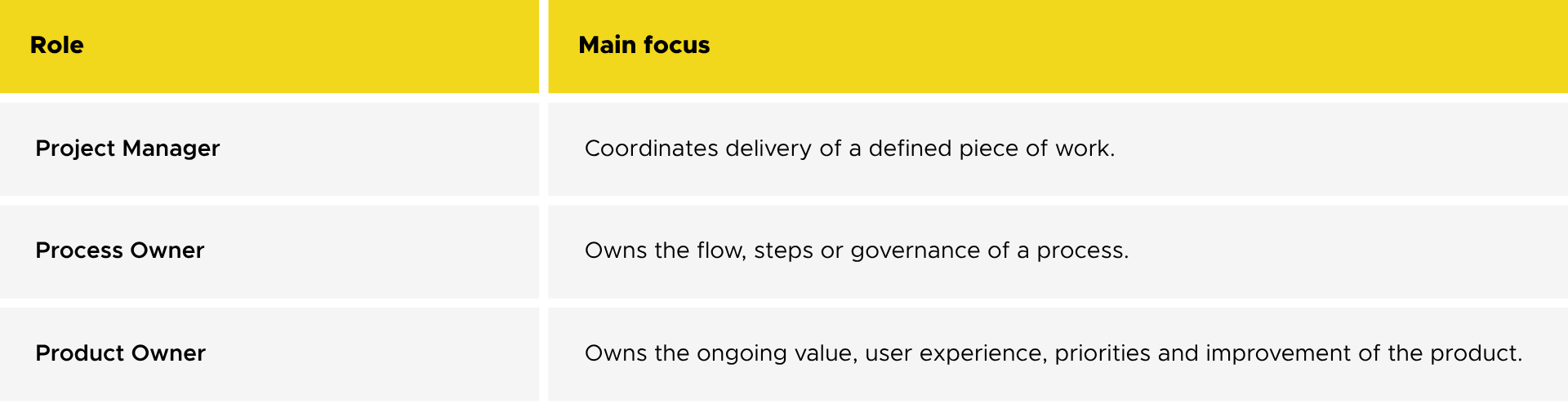
It is also not the same as process ownership. A process owner may own the steps, flow or governance of a process. A Product Owner owns the broader value delivery system around it.
That includes discovery, design, technology, service, data, KPIs, release, maintenance, cost, features, adoption, continuous improvement and, when needed, sunsetting.
We explored this distinction in more detail in our article HR Product Owner versus HR Process Owner, because both roles matter. But they are not the same thing.
A simple way to think about it is this: a process should run well. A product should create value for someone.
Why experienced HR professionals are well placed for the role
Many HR professionals with five or more years of experience are already closer to Product Ownership than they may realise.
If you have led HR projects, developed processes, shaped people strategies, worked with stakeholders, improved employee experience or supported organisational change, you already understand how messy real HR work can be.
You know that a good idea on paper does not automatically work in the organisation. You understand people, culture, adoption, leadership expectations and operational reality. You can see how one decision affects another part of the system.
Experienced HR professionals often already see the system. What they lack is the empowerment, structure and decision discipline to influence it end to end. Product Ownership provides this.
Riina Hellström, Founder & Agile Enterprise Coach
That is valuable.
What experienced HR professionals often lack is not insight. It is the structure, empowerment and decision discipline to influence the whole experience end to end.
Product Ownership gives you a stronger frame for doing that with practical methods and tools. It gives you ways to prioritise, facilitate workshops, discuss different perspectives, make decisions and move forward. It also gives you stronger argumentation for saying no and helps you reduce wasteful collaboration, endless back-and-forth and unclear decision paths.
This is especially valuable for any senior HR professional who is already having difficult stakeholder conversations but may not have a clear product framework to guide decisions.
HR Product Ownership increases influence
Influence in HR is often misunderstood.
It is not about being in every meeting. It is not about collecting every stakeholder opinion and trying to keep everyone happy. It is not about escalating every decision to a steering group.
Product Ownership creates influence through clarity.
A Product Owner can go to leaders and say: “Here is what we are prioritising, and here is the evidence behind that decision.”
That changes the conversation.
Leadership input still matters. Leaders bring organisational context, strategic priorities and business constraints. But their opinion becomes one important source of insight, not the only decision-making mechanism.
This is a significant shift for HR. Many HR products are still shaped by the loudest voice, the most senior opinion or the latest urgent request. Product Ownership moves HR towards a more professional decision model based on users, data, value and trade-offs.
It also speeds things up.
When ownership is fragmented, work slows down. Decisions bounce between teams. Technology constraints are discovered too late. HR services inherits issues it was not involved in designing. Feedback disappears into nowhere. Everyone is busy, but value delivery is slow.
A properly empowered Product Owner gives the work a clearer route forward. They help the team decide what to do now, what to do later and what not to do at all.
For HR professionals who want to increase their impact, that is powerful. You are no longer just moving work around the organisation. You are shaping what gets built, why it matters and how success will be measured.
Product Ownership works even if your organisation is not agile
A common misunderstanding is that Product Ownership only makes sense in organisations that already work in agile teams. It does not.
Of course, Product Ownership is easier when the organisation has agile structures, cross-functional teams and clear product accountabilities. But many HR professionals are not working in that environment yet. They are working in traditional HR functions, matrix organisations, Centres of Excellence, HR operations, HR technology teams or transformation programmes where ownership is still evolving.
That does not make Product Ownership irrelevant. It makes it useful.
Even if your organisation does not call itself agile, you still need to understand users, prioritise work, make trade-offs, manage stakeholders, define value, deliver in smaller increments and learn from feedback. These are not just “agile organisation” skills. They are modern HR delivery skills.
- Product Ownership gives HR professionals a practical structure for moving forward without waiting for the whole organisation to transform first.
This is especially true when AI is involved. AI-enabled HR work cannot always be planned perfectly upfront. You need to experiment, test, release, learn and improve. A long waterfall plan may give the illusion of control, but it often struggles when the work is uncertain, technical or fast-moving.
You may not have the perfect set-up. You may not have full empowerment. You may not have a dedicated agile team. But you can still start using Product Ownership thinking to clarify what matters, reduce unnecessary complexity and make better decisions about the work you are responsible for.
When is the right time to participate in HR Product Owner training?
For HR professionals who are ambitious, curious and ready for a better way of working, Product Ownership offers a practical next step.
Product Ownership moves you from...
- Supporting work to shaping it.
- Coordinating delivery to owning value.
- Being pulled into every stakeholder request to making clearer, evidence-based decisions.
Product Ownership is a trainable capability. But the right time to build it is not only when “Product Owner” appears in your job title.
It may be time to participate in HR Product Owner training when you are responsible for something meaningful and need a better way to move it forward. That could be a new HR product, a redesign of an existing service, a major employee experience improvement, an AI-enabled HR solution or a large HR transformation priority.
It may also be the right time if you are tired of saying yes to too many stakeholder requests, struggling to prioritise competing needs or finding that every decision gets reopened, escalated or diluted.
Training helps when you need more than theory. You need practical tools for stakeholder conversations, user discovery, prioritisation, backlog thinking, metrics, product roadmaps and trade-off decisions. You need a way to turn messy input into clearer choices.
We train Product Ownership specifically for HR professionals because generic Product Owner training often does not translate well enough into HR reality. HR products are not abstract software examples. They involve people, culture, leadership expectations, HR technology, service delivery, employee experience, data, AI and organisational constraints.
You can learn more about what our Agile Product Owner training involves here.
Product Ownership is not just a new title. It is a more disciplined, empowered and impactful way for HR to work.
And if you are ready to deliver better solutions, influence priorities and show measurable impact, it may be the role you should be paying attention to next.
